Blade Runner 2049
on Fujifilm
The Roger Deakins colour grade that pushed two thousand teal-orange wedding photos into existence. But the Blade Runner 2049 palette is more than the cliché — here's what the cinematography actually does, and the Fujifilm recipes that translate it for stills.
Roger Deakins (cinematographer) and Joe Walker (editor), 2017. Won the Academy Award for Best Cinematography. The film is colour-graded in distinct zones: cold blue cityscape, sodium-orange wasteland, white-haze interiors.
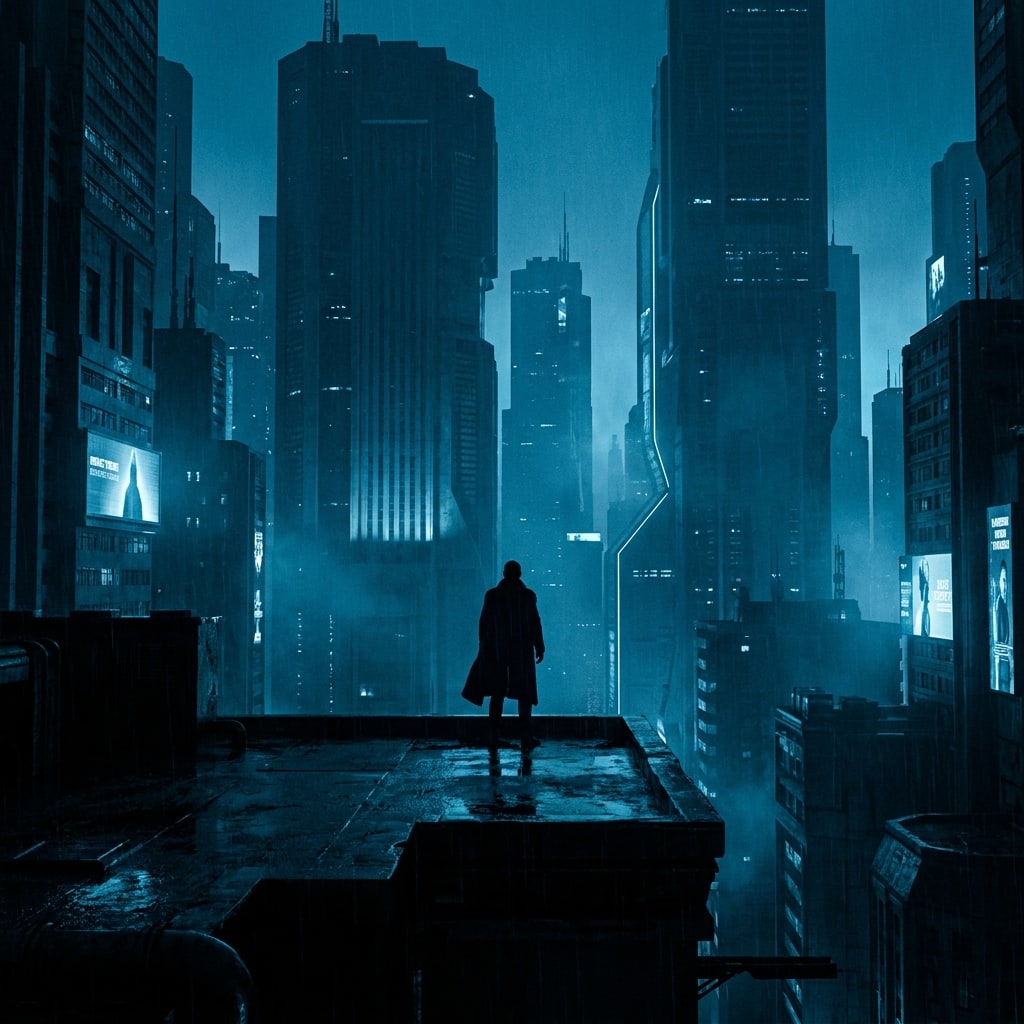
Reference look
What we're translating
A representative scene in the Blade Runner 2049 register — the colour, contrast, and composition the recipes below try to land on a Fujifilm body straight out of camera.
AI-rendered approximation (Gemini 3 Pro Image, prompted to match the Blade Runner 2049 aesthetic). Not a frame from the source material — used for visual orientation only.
What people mean by “Blade Runner 2049 look”
The shorthand “Blade Runner 2049 grade” usually means the sodium-orange Las Vegas sequence — K’s car crossing the irradiated wasteland under an opaque amber sky. But the film actually runs four distinct colour zones, each lit and graded separately:
- Cold blue cityscape — saturated cobalt, low key, hard rim light on faces.
- Sodium amber wasteland — opaque orange fog, silhouettes, no detail in highlights.
- White interior haze — overexposed white, almost no colour, soft shadowless light (Wallace’s headquarters).
- Neutral memory sequence — naturalistic, the only zone with normal colour.
Most “Blade Runner” presets and recipes mash these into a single teal-and-orange — which is the Skyfall look (also Deakins), not 2049. The actual film is more disciplined. Here’s how to translate two of those zones on a Fuji sensor for still work.
Translating the cold-blue cityscape
This is the most photographable zone for street and night work. Three moves:
- Eterna or Classic Negative — both films hold the cool desaturation Eterna’s bleach-bypass cousin pushed in 2049. Eterna alone is closer to the night LAPD scenes; Classic Negative is closer to K’s apartment interiors.
- Negative white-balance shift on red, positive on blue — pushes the whole frame cyan-cold without crushing skin.
- DR200 + negative shadow — Deakins lets blacks hold dense; no lifted shadow rescue.
The Eterna Overcast Rain recipe is built around exactly this zone — moody, restrained, cool. Use it for night street, neon-lit interiors, and rainy industrial scenes.
Translating the sodium-amber wasteland
This is harder and only works in specific light — golden hour through smoke or haze, sunrise through pollution. The trick is to let highlights blow out intentionally (DR100, no highlight protection) so the amber becomes opaque rather than detail-preserving. Pair with Classic Chrome and positive WB-red shift; the recipe is Classic Chrome Overcast Moody pushed warmer.
The Fujifilm camera can’t reproduce a controlled-haze grade, but it can reproduce the colour-and-contrast envelope when the light naturally cooperates.
Why this isn’t just teal-and-orange
The teal-and-orange “Hollywood look” is built by complementary-colour push — boost orange in skin/highlights, push everything else toward teal. 2049 does the opposite of that for most of its runtime: it commits to single-hue zones (cobalt blue OR sodium orange, never both in the same frame). A real 2049 recipe should feel monochromatic, not split.
What to look for
A real 2049 translation, not generic moody cinema:
- The frame commits to one colour temperature — fully cool or fully warm, no split.
- Skin is allowed to be the wrong temperature (cyan-cold under blue light, never “rescued” warm).
- Detail is allowed to go missing in highlights (white office windows, sodium sky).
- Shadows hold dense without crushing — there’s structure in the dark, just no colour.
Recipes that deliver it
2 recipes · ready to shoot
-
Emulates Classic Chrome editorial / overcast documentary
Overcast Moody
A muted, slightly cool Classic Chrome recipe built for overcast city days — deep shadows, restrained colour, and the documentary weight grey light deserves.
-
Emulates Eterna cinema stock under flat daylight
Eterna Overcast
A soft cinematic Eterna recipe for overcast and lightly rainy days — lifted shadows, low saturation, and a cool cast for wet streets and muted architecture.