Acros Street: Documentary Black & White
A punchy Acros recipe built for street work — deep blacks, visible grain, and enough highlight headroom to keep shop windows and bright signs from clipping.
Street · Black & white · Documentary
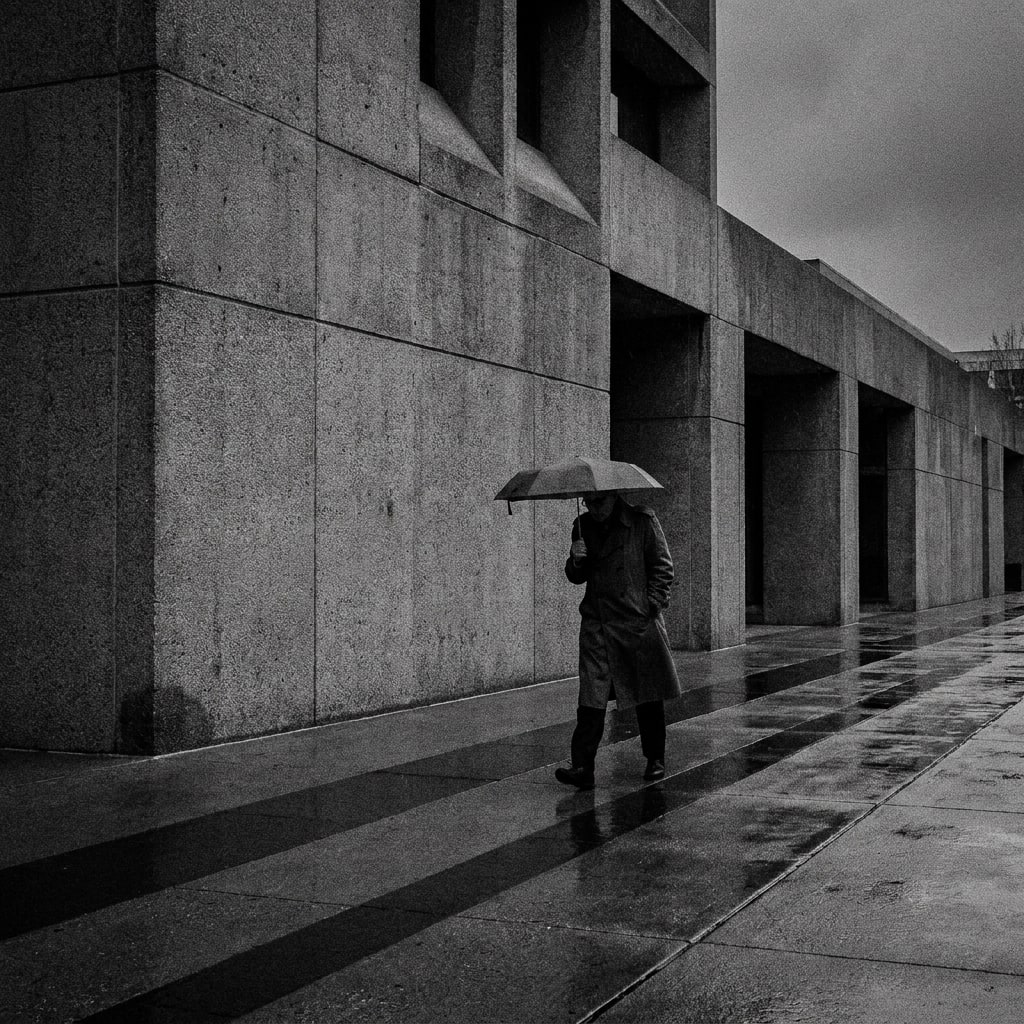
Sample look
What this recipe is reaching for
A representative scene in the Tri-X 400 push-processed for street register this recipe targets — the colour, contrast, and mood it tries to land straight out of camera.
AI-rendered approximation (Gemini 3 Pro Image, prompted with the recipe's Fuji simulation and settings). Not a photograph shot with this recipe — real shots will vary with your light and subject.
Settings
15 parameters
Look
- Film Simulation
- Acros + R (red filter)
- Dynamic Range
- DR400
Tone
- Highlight
- +2
- Shadow
- +3
Color
- Color
- 0
- White Balance
- Auto
- WB Shift
- Red 0 · Blue 0
- Color Chrome FX
- Off
- Color Chrome FX Blue
- Off
Detail
- Sharpness
- +1
- Noise Reduction
- −4
- Clarity
- +3
Texture
- Grain Effect
- Strong, Large
Exposure
- ISO
- Auto, up to ISO 6400
- Exposure Comp.
- -1/3 to -2/3 EV
Street photography on Acros is less about prettiness than about decisiveness — blacks that actually go black, mids that hold a face under awning shade, and highlights that survive a backlit shop window. This recipe leans into the Acros+R variant because the red filter response weights skies and blue shadows downward, which is exactly what an urban frame needs to keep buildings from going muddy against an overcast sky.
Why this base
Acros R gives the deeper tonal separation that plain Acros softens. Shadow +3 crushes the low end into real black rather than a polite grey, while Highlight +2 keeps the curve from going chalky on neon, transit signage, and white storefronts. DR400 is doing the unglamorous work underneath — it preserves the highlight roll-off so the +2 highlight setting doesn’t clip the brightest signs, which is the failure mode of most punchy black-and-white recipes. Grain Strong / Large is non-negotiable for the documentary register; it tells the eye this is a photograph of a place, not a clean render.
How to shoot it
Meter for the highlights and let the -1/3 to -2/3 EV bias do the rest. The combination of negative EV, Shadow +3, and DR400 means you can shoot at midday into hard contrast and still keep something readable in window reflections. Clarity +3 adds local contrast around edges — useful for textured walls, signage type, and the grain of wet pavement — without the halos a global Sharpness push would produce; Sharpness sits at a restrained +1 so fine detail in distant crowds doesn’t get crunchy. Noise Reduction at -4 is deliberate: it lets the Strong grain stay structural rather than getting smoothed into mush, and it preserves micro-detail on fabric and skin at higher ISOs. Auto white balance is fine because the file is monochrome — the WB shifts are zeroed for the same reason.
What to avoid
Don’t expect this look to flatter portraits at close range. The Acros R response darkens lips and reddens skin tones into a heavier grey, and Shadow +3 will sink eye sockets under hard overhead light — that is the documentary trade. For environmental portraits in soft light, switch to base Acros (no filter) and pull Shadow back to +1. Also avoid stacking this with in-camera Clarity on long exposures: Clarity slows the buffer noticeably on X-Trans IV bodies, so keep it for single-frame street work rather than burst sequences.
X100VI · X-T5 · X-T50 · X-E5 · X-H2 · X-H2S · X-S20 · X-Pro3 · X-T4 · X100V · X-T30 II
Questions
4 answers
The R filter darkens blue skies and deepens shadows on brick and asphalt, which gives street frames more separation between sky, building, and pavement. Plain Acros is flatter; Monochrome lacks Acros's grain structure entirely.
Not as written. The X-T3 has no Clarity control and its Acros implementation is the older X-Trans IV recipe, so the +3 Clarity push won't apply. Drop Clarity and raise Sharpness to +2 as a substitute.
DR400 protects the highlights in lit signage, white shirts, and shop windows while the -1/3 to -2/3 EV bias keeps midtones low and shadows genuinely black — the documentary look depends on both working together.
On 26MP X-Trans IV it reads as honest film grain at web and print sizes up to A3. On 40MP bodies (X-T5, X100VI) Large grain is more pronounced — drop to Small if you want a cleaner result.